How To Help

To contribute to the Ranken Jordan junior golf program or to ask any questions please e-mail me at kcornpga@gmail.com. This blog is not affiliated with Ranken Jordan. The views expressed on this blog are those of the author and not those of Ranken Jordan. Thank you for reading!

Sunday, March 2, 2014

Helping the Whole Family Heal

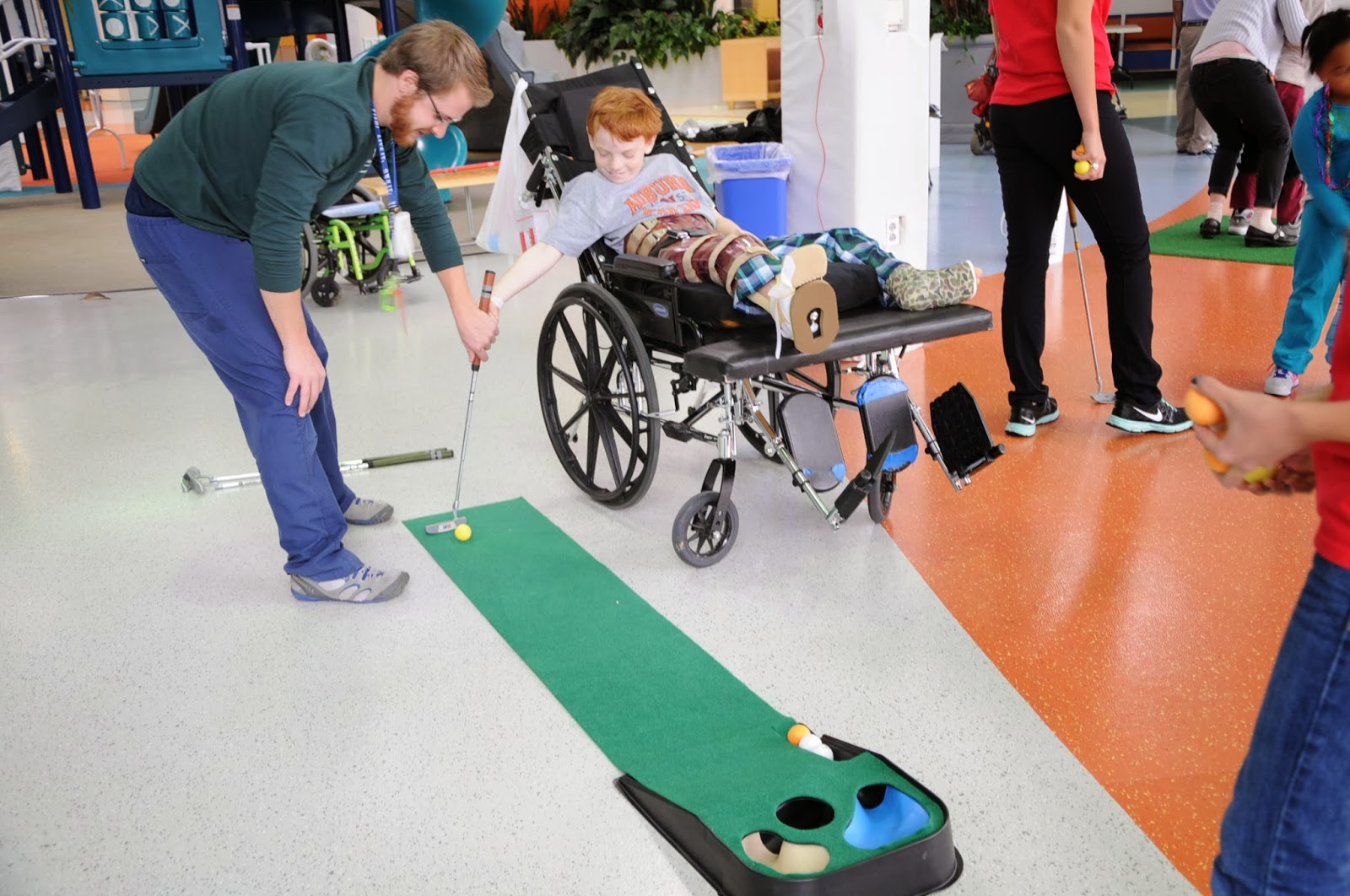
Spend much time at Ranken Jordan Pediatric Bridge Hospital or on their website and you are likely to repeatedly encounter the phrase "care beyond the bedside."  This phrase permeates all they do at the hospital and is evidenced by the activities you see the kids doing as they transition from hospital to home.  If you walk into Ranken Jordan expecting to see kids laying in their hospital beds or sitting in their rooms playing video games then you are in the wrong place.  Instead you will see kids playing basketball, air hockey, or golf.  And the one most important thing you will see with all the kids is they are smiling, laughing, and having fun . . . and getting better.

The golf program at Ranken Jordan is a great example of their philosophy of getting the kids up, out of bed, and out of their rooms as they journey down the road to recovery.  Golf has proved to be a wonderful healing tool and has been used in all manners by the medical team at Ranken Jordan.  One of the greatest things about teaching the kids how to play golf, and I have discussed this repeatedly on this blog, is the wide range of physical, mental, emotional, and social benefits the kids receive from participating in the game of a lifetime.  But one of the often overlooked benefits of the kids playing golf is the benefit received by the family members who may have never thought it would be possible to have a new junior golfer in the household.

Many times during the almost 3 years since our program debuted I have been standing with a parent, sibling, or grandparent as they watch ball after ball go flying long and straight.  Often the family members start off with a feeling of disbelief at seeing something they never dreamed possible is in reality possible.  That feeling quickly dissipates and is replaced by extreme excitement, joy, and pride.  There is nothing as rewarding as putting smiles on the faces of the kids at Ranken Jordan who I am so fortunate to teach how to play golf.  But almost as rewarding is seeing the smiles and tears of joy from the parents as they watch their child do what may have been considered impossible.  Seeing your child in the hospital is probably one of the most difficult things any parent will encounter.  But when they can see the child having fun, smiling, and doing something new while they are recovering, that pain and difficulty subsides just a little bit.

Golf can be a very inclusionary sport and activity for kids and families alike.  This allows the game to serve as a type of continuum of care for the kids, siblings, and parents.  By showing them while they are in the hospital that they can play golf, everyone has something to look forward to once the child has gone home.  I have heard from many of the kids that they never thought they would be able to play sports, or play sports again, after leaving the hospital.  After being introduced to golf they feel differently and so do their parents.  One of the best comments (and I take it as a compliment, too) I have heard came from a father who said, "I never thought my son would be able to play golf.  Now I can't wait to get to the golf course with him!"  Golf is helping kids heal and helping families through a difficult time.  And as Ranken Jordan's website says, they "are a place where the impossible becomes possible."

Saturday, February 15, 2014

Success

Every time you turn on the television to watch any professional golf tournament you will see great shots being struck.  After each of those shots you will typically hear an explanation about why that shot was successful (or in some instances unsuccessful).  The insight provided by Sir Nick Faldo, Johnny Miller, or Jim Nantz is almost always spot on.  One of the things I find amazing when I watch a golf tournament is how the players and broadcasters define success on the golf course.  In almost all of the golf lessons I have given in my career I tell players that one of the keys to scoring well is making your poor shots as good as possible.  For instance, if a bad tee shot typically would put your ball out of play, improve your game to the point of being able to keep that bad tee shot in the rough allowing you to play on without adding a penalty stroke.

There is one area of my golf instruction that we do not necessarily measure success in the same ways as the "everyday" player or the professional golfer that you watch on TV.  I am sure that anyone who has read this blog regularly already knows that the area I am talking about is my time teaching the kids at Ranken Jordan Pediatric Bridge Hospital.  To the kids there, a successful golf shot can be determined by any number of reasons, only a few of which actually involve the game of golf.  In the past few weeks we have seen kids hit successful shots for the following reasons:
  • Better angle of attack into the ball leading to a more consistent trajectory
  • Less movement of the head while putting leading to better contact
  • Being able to sit up in a wheelchair long enough to hit 5 golf shots
  • Physically holding the golf club with 2 hands to hit the ball
  • Standing up to hit the golf ball
  • Having the ability to turn their head to look at the ball
These are only a few of the hundreds of reasons we have seen successful golf shots struck every week during our golf clinics.  Of course it isn't uncommon to see good golf shots being hit on several days of the week . . . the kids love playing golf balls so much that they have the therapists get the clubs out as often as possible!


I understand that everyone who plays this game has a different way of determining how successful or unsuccessful a particular shot is.  This is one of the great things about the game --- anyone can play and enjoy golf regardless of the level of their play.  What Phil Mickelson considers a "bad" shot is likely better than what many golfers consider a "good" shot.  At Ranken Jordan one of the ways we determine the success of a shot is by measuring how much good playing the game is doing for each individual kid.  In a lot of cases getting the ball airborne can be secondary, although you will never see a bigger smile on the face of a kid than the first time they see the ball they just hit sailing through the air!


Our junior golf program is nearing its 3 year anniversary (May 10, 2014 is the date).  During that time we have seen many, many successful shots that would go unnoticed by anyone who was unaware of the entire story.  I have been fortunate to go to the Masters, U.S. Open, Ryder Cup, PGA Championship, Bay Hill, etc., and have seen many great shots hit at each tournament.  None of them compare to what I see weekly in a very special pediatric hospital.  This morning I watched a young lady hit a ball all the way across Warner's Corner when only a few short months ago she barely had the strength to sit up in her wheelchair and allow me to help her swing the club.  One of the single greatest shots, and maybe the greatest, I have ever seen happened just before Christmas 2012 when I watched a 13 year old boy get out of his wheelchair, take his first steps ever up to a putting green, and roll a few putts before walking back to his wheelchair.  To this day I still am unable to tell that story with dry eyes!  When I am out playing or practicing on my own game these are the shots I think of as I try to improve my game.  What I see these kids do every week inspires me to be a better player and a better person.  They have hit some miraculous shots and I am very lucky to be a small part of what they accomplish every week!

Thursday, February 6, 2014

Golf Helps the Healing Process

The simplified purpose of any pediatric healing facility is to help kids get better and go home to their family and friends.  Now I realize there is a lot more going on in each and every pediatric hospital or rehabilitation center around the country, but the basic goal of every one is to heal children and get them home.  For each and every patient, many procedures, treatments, therapies, and tools are used to accomplish this goal.  Often times there are standard protocols that can be followed and will work with many of the patients.  Then there are those times where health care professionals have to think outside the box to get through to a child and kick-start their healing process.  I have witnessed some of those occasions and can confidently say that golf is a healing tool.


How can I so confidently make a statement like that?  After all, I am a PGA Professional with no formal healthcare education (although I have stayed at Holiday Inn Express).  What grounds do I have to stand up and say that golf is a healing tool?  The basis of my confidence in saying that is I have seen it happen time and time again.  Week in and week out I have watched kids improve their strength, stamina, balance, coordination, motor skills, etc.  Through my work at Ranken Jordan I have had the honor of meeting and talking to people like Zakki Blatt and Kyle Miller who are prime examples of the significant healing role golf can play in the life of a child.  Do yourself a favor and read their Golf Save My Life articles by Max Adler from past Golf Digest magazines.  Click HERE for Zakki's story and HERE for Kyle's story.


Another contributing factor to my confidence in saying golf is a healing tool occurred in one of our recent golf clinics at Ranken Jordan.  During one of our clinics this winter we had a young man, maybe 7 or 8 years old, who started playing golf from his wheelchair.  Over the course of several weeks his therapy progressed to the point where he was standing for short periods of time with the aid of a therapist.  On multiple mornings, he would come to golf for a short time, work on his swing in his wheelchair, and then head to therapy (times overlapped but he always wanted to make some time for golf).  Each morning it never failed, he would leave for therapy only to return a few minutes later with a therapist in tow.  His therapist told us that he wouldn't stand for her but he would happily stand up to hit golf balls!  To go along with the physical benefits he received through playing golf we also saw changes in his interaction with the other kids and his own happiness.  He always had to watch the other kids hit a few shots, talk to them, and had a smile plastered on his face the entire time.

Jeff Middleton, PGA, Zakki Blatt, & Kevin Corn, PGA
For many people golf is simply a way to escape for a short time or unwind after a stressful day.  Other folks, like me, make our living through golf.  To the kids I teach every week golf is improving their lives.  Regardless of how big or small the improvements are, the fact remains that golf is making a difference.  These kids deserve the opportunity to learn the game of a lifetime and enjoy some of the healing benefits it provides.  Why is this so and what can it really do for them?  Contact me and I will gladly provide more information and details.  Simply stated, when the opportunity is presented to the kids it leads to . . . Possibility.

Thursday, January 30, 2014

Swinging Away With Dakota

Determination and perseverance are two very important qualities to have for anyone who wants to improve their golf game.  Golfers everywhere who have taken a lesson or tried to make a swing change completely understand this.  Trying to incorporate something learned from your local PGA Professional or from one of the many great instructional shows on the Golf Channel is indeed a daunting task.  Initially many changes to your set up, grip, or swing will feel very uncomfortable and likely have you mumbling under your breath (or loudly depending on how uncomfortable).  Looking back on my own game I remember grip changes and swing plane changes that had me feeling like I had never before held a golf club.  I recall thinking there is no way I am going to be able to make these changes and feel good making a swing.  This type of thought is common on driving ranges and golf courses across the United States and around the globe.  Once we get a golf club in the hands of our junior golfers at Ranken Jordan Pediatric Bridge Hospital in St. Louis those thoughts never enter the minds of the kids.


Those of you who read this blog regularly might recall a young man I have spoken of often and fondly named Dakota.  Since getting over his initial reluctance to play golf he has become one of our most dedicated players.  To Dakota Saturdays are golf days.  Of course every other day of the week is also a golf day in his mind!  I know every week when I get to the hospital I will hear his stories of how many golf balls he hit during the week or what he's working on in his golf swing.  I cannot tell you how happy it makes me to hear from the kids that they enjoy golf so much that they want to play more than just one day a week!  During his time at Ranken Jordan we have had to make several changes and modifications to Dakota's swing.  In his case I say "we" because it truly is a team effort.  He seems to make as many suggestions about improvements as any of the golf professionals who work with him.  At a recent clinic those suggestions were freely flowing but they were not related to swing changes.  Dakota was directing Janine Roe, Community Programs Director at Ranken Jordan, on how to properly position his hospital bed so he could make the biggest swing possible.


This type of thing is not uncommon at Ranken Jordan.  As the kids progress through their rehabilitation and their bodies heal we naturally have to make changes to how we teach them.  Sometimes the changes include casts on their left arm one week and right arm the next week, improvements in strength, flexibility, and stamina, or getting out of their wheelchair to take their first steps and playing golf standing up.  And then there are the times that the kids go back and forth from their hospital bed to their wheelchair with some time in a golf cart mixed in.  That was exactly the case this past week with Dakota.  He came to golf in his hospital bed and refused to let it slow him down.  Due to being in the bed he was unable to make the same long, smooth swing that he typically does from his wheelchair, but he quickly realized he could still work on the swing changes we have been focusing on the past couple of weeks.  To get in the best position to swing he certainly kept Janine on her toes until she had his bed situated just right.  After that the volunteers picking up golf balls quickly became human targets!


Dakota is easily one of the most inspirational people I have been fortunate enough to meet through the game of golf.  After initially resisting the game he soon learned he loved to play and has worked hard to see continuous improvement.  In his own words he has told me that "golf turns a bad day into a good day."  Many of us (I am at the top of the list) will use a stiff shoulder or sore back as a reason not to play golf or practice.  Dakota doesn't let being in his hospital bed or anything else keep him from his practice.  He perseveres through the difficulties put in front of him and is determined to keep playing.  In fact, there is a good chance he is working on his golf game as you read this.  Which reminds me, I better get in some putting practice on the carpet so Dakota doesn't beat me next week!

Sunday, January 19, 2014

Giving Kids Their Lives Back

Last night Ranken Jordan held its annual Gala at the Ritz-Carlton in St. Louis, Missouri.  To say the night was incredible would be a gross understatement.  I feel very fortunate to have been able to attend this event for the first of I hope many times.  Throughout the night hundreds of thousands of dollars were raised for the hospital that excels at producing miracles for kids and their families on a regular basis.  Along with the money raised, one of the highlights was the unveiling of a new video explaining exactly what Ranken Jordan does for the kids and their families (you may click the link below to view it).  Ranken Jordan's Chief Medical Officer, Dr. Nick Holekamp, said it best during his speech when he commented that "the acute care hospitals save kids lives.  It's our job to give them their lives back."  This thought was a common theme throughout the night.


As the night progressed Dr. Holekamp's quote really resonated with me as I kept thinking about it in regards to our junior golf program.  Every week I see more examples of exactly how golf is giving the kids their lives back.  When most people see a child laying in a hospital bed, sitting in their wheelchair, or walking with the aid of a walker as well as a therapist, they do not think of putting a golf club in their hands.  I do.  Giving these kids the opportunity to learn how to play golf regardless of their physical condition is one piece of the puzzle to giving them their lives back.

That was evidenced once again during our most recent clinic.  Typically our golf clinics are scheduled for one hour each Saturday morning.  However this last week wound up going for almost 2 full hours as the kids did not want to stop hitting!  There were very few breaks to rest and were certainly no complaints that hitting shot after shot was boring.  All of the kids involved had huge smiles pasted on their faces and had a great time.  They putted, chipped, and ripped drivers off the windows.  Any of the volunteers who dared to walk out and gather golf balls were quickly labeled "human targets."  Because we use Almost Golf Balls the kids can get away with hitting the windows and volunteers without fear of damage or harm.  To go along with all of the smiles and laughs we had, there was one little boy who had flat out refused to play the prior week.

While I was helping one of the other kids smooth out their putting stroke I felt a tap on my shoulder.  The young man who didn't want to play last week had rolled his wheelchair up to me and asked which putter he could use.  We quickly got him set up with the right U.S. Kids putter and had him stroking putts in no time.  It didn't take long before he asked if he could take some full swings.  Just as quickly as the putting mat appeared, it was replaced with an astroturf hitting mat and the putter was replaced with an 8-iron.  The first swing sent the ball in the air and it landed right in the middle of the target net!  He was hooked!  His next comment left me stumbling for a response when he said "now I want to do this standing up."  The young man who last week didn't want to even try golf and refused to get out of his wheelchair now wants to hit golf balls standing up?!?  Still wondering how golf factors into giving these kids their lives back?


Stories like this are occurring every week at Ranken Jordan - Pediatric Bridge Hospital.  Sometimes they involve the golf program and I am thrilled when they do.  Looking back on that incredible golf clinic and also thinking of a comment from the Gala during the speech from St. Louis Cardinals Manager & Ranken Jordan Board Member Mike Matheny brings an instant smile to my face.  During his speech, Mike said that "you can't have success without serving others."  While I perfectly understand what he means by that, I can only hope that my small amount of service to these kids will contribute in some way to their success in life.

Saturday, January 11, 2014

Reaching A Milestone

In order to progress and move forward in any aspect of life goals need to be set and milestones will be reached in the successful completion of those goals.  Anyone who has ever played golf knows that this is especially true as a beginner tries to learn the game or an experienced player works to lower their handicap.  It does not matter if you're learning the game at an exclusive country club or working on your swing while you are a patient in a pediatric hospital.  Goal setting is vital to measuring your progress and watching your game improve.

The kids who participate in our junior golf program at Ranken Jordan are no different than any other golfer around the world.  Many of them establish goals and work very hard to meet those goals.  Each week I hear comments like "I've never hit a golf ball that far" or "this is the most putts in a row that I've ever made!"  Earlier this week I had one of the junior golfers comment to me that he had gotten much better at controlling the trajectory of his golf ball.  He could now hit it high, normal, and low on command.  Did I mention he is doing this while swinging from a wheelchair?

Today at Ranken Jordan we had one of our most loyal junior golfers reach an incredible milestone.  This milestone had very little to do with her golf game.  Rather, it showed the progress she has made with her physical recovery and the hard work she has been putting in with her therapy.  If you ask her, she will tell you that golf has become an important part of her therapy program.  She has grown to love playing the game and gets excited by seeing the flight of a well-struck shot.  You may think that this milestone she reached was a longest drive or lowest score on the mini golf course we occasionally set up in Warner's Corner.  If those types of thoughts entered your mind you would be incorrect.  The milestone she reached that left me in total awe was reaching over with her golf club and raking the next golf ball into position to hit.

In past posts I have written about this incredible young lady.  When she first began playing golf she could not sit up in her wheelchair and hit balls for more than a couple of minutes without needing a break.  Due to a lack of physical strength we had to go hand-over-hand for her to hit the ball.  Through hard work and sheer determination she has progressed to being able to hit golf balls on her own for an hour at a time.  Today, for the first time, she showed the hand-eye coordination and steadiness to be able to rake the next golf ball onto the mat to hit.

From a golf standpoint you may think that this is relatively insignificant.  Compared to establishing a career low score maybe it is.  Then again maybe it isn't.  In this particular case I am not overly concerned about what it means for her golf game.  What makes me the happiest is watching her recovery from the day she started playing golf until now.  This is where the game of golf illustrates the important role it can play in the lives of children in pediatric healing facilities around the globe.  Because this junior golfer wants to improve her golf game and get better she has worked harder in therapy and received additional therapy, albeit unknowingly, while playing golf.  The next time you are at the driving range and absentmindedly rake the next ball from the tray, maybe you will think of one of my favorite golfers and the progress she has made in her recovery because of golf.

Friday, January 3, 2014

Springtime in December

Last weekend at Ranken Jordan there was a camp similar to the ones held in the summer.  You may recall me writing about the camp in which we had a large group of kids and a great mix of patients, day treatment patients, and community participants.  Looking up and down the line of kids hitting golf balls you saw kids in wheelchairs, kids requiring help to stand, and able-bodied kids, all of whom were swinging away.  The two days we had golf during those summer camps were a wonderful example of how golf can be a completely inclusive sport.  Last Saturday's camp provided the same type of example.

An unseasonably warm December day actually allowed us to get the kids outside and enjoy some mid-winter sunshine.  Not only did we have a great turnout of kids, but there was a great involvement from the local golf community.  Oak Brook Golf Course's Mike Suhre, PGA, Ann Briar Golf Course's Kevin Schaeffer, PGA, and Metropolitan Golf Association Executive Director Curt Rohe all came out to lend a hand.  Walking up and down the line helping the kids, I saw nothing but smiles on the faces of everybody that sunny morning.  As always, those of us helping took away as much or more from that day than the kids!

While all of the kids had a great time, improved their golf swing, and left smiling, there were two kids who really stood out to me.  The first one, Dakota, I have talked about several times in the past.  He is the young man who we took to the golf course earlier this summer and has not stopped smiling since!  Last Saturday showed exactly how far his golf game has come since he stopped thinking the game is "stupid and boring" and picked up a club.  Anyone who has played golf knows that "click" you hear when you strike a golf ball just perfectly.  This past week Dakota heard that on virtually every shot he hit.  I was absolutely amazed at how consistently he hit the ball.  Shot after shot was sent high and straight across the field. Talking with Dakota after the golf clinic we both agreed that this was the best he has hit the ball since he started playing.

Dakota at The Quarry at Crystal Springs Golf Course
The second junior golfer who stood out to me was a young patient with limited use of one side of their body who took a few swings then walked away with a frown.  I went over and asked why I didn't see a smile.  The conversation went something like this:

Junior golfer:  "I stink at golf.  I can't do this.  My hand won't let me hold the club, my arm won't let me swing the club, and my leg makes it tough to stand up to the ball.  I just stink at golf."

Me:  "Why don't you give it one more try and let me watch you hit a few balls?  I'll help you and we will get you hitting the ball better than ever."

Junior golfer:  "OK, I guess I'll try one more time.  But I'm only hitting 3 balls.  I stink and don't want to do it."

With that the youngster picked up a club, went back to the pile of golf balls, and got ready to hit the 3 balls as promised.  I made a slight adjustment to the junior golfer's grip to allow the left hand to better hold the club, slightly modified the stance, and then it was time to swing away.  Ball #1 was sent flying through the air towards the target . . . and there was almost a smile.  Soon after ball #2 was airborne and had the same result . . . but with a little smile.  Then came ball #3 which wound up being the best shot yet . . . and got a huge smile!  I told our new golfer thank you for hitting the golf balls for me and how great the new golf swing looked.  The next thing I knew another ball was being teed up and sent flying.  After about 20 more swings it was time for a little break.  So much for only hitting 3 golf balls!  When the practice session was over I got a huge smile and was informed that this special junior golfer had decided, "I don't stink at golf."

I always enjoy the camps at Ranken Jordan as they allow for all of the participants to interact and simply be kids.  This is one of the great things golf is doing for them.  The game allows for everybody to interact equally and shows that they are all just kids.  Everybody uses the same equipment and hits from the same spot.  One of the best parts of days like this are watching the able-bodied kids look on in awe as Dakota launches shot after shot past their best drive!  But of course nothing is better than seeing the smiles and hearing the laughter from kids playing a game.